
Choosing the right site dumper can affect material-handling efficiency, productivity, operating costs and day-to-day site performance. Construction projects often require soil, sand, aggregates, debris and other bulk materials to be moved across uneven ground, making the right transport equipment essential.
For contractors and equipment buyers, selecting a construction site dumper should be based on the project environment, required capacity, manoeuvrability, tipping requirements and operating conditions—not simply purchase price.
Modena Machinery Trading LLC offers a site dumper range for construction and industrial material transportation. The listed BMTP models include D 800 F, D 1200 F and D 1200 HD.
A site dumper is a compact construction machine used to transport and discharge materials around a worksite. Unlike conventional road trucks, site dumpers are designed for construction environments where surfaces may be uneven, access may be restricted and materials need to be moved over relatively short distances.
Depending on the design and application, a site dumper can be used for soil, sand, aggregates, gravel, concrete, excavated materials, construction debris and other general site materials.
Start by considering the amount of material the machine needs to transport during normal operations.
A dumper that is too small may require more trips, increasing operating time and reducing productivity. A machine that is considerably larger than required may increase equipment and operating costs. Select the model according to the material being transported, working conditions, site layout and the manufacturer’s specifications.
Construction sites often involve mud, loose soil, gravel, slopes and uneven ground. For this reason, a wheel dumper should be evaluated according to the terrain where it will operate.
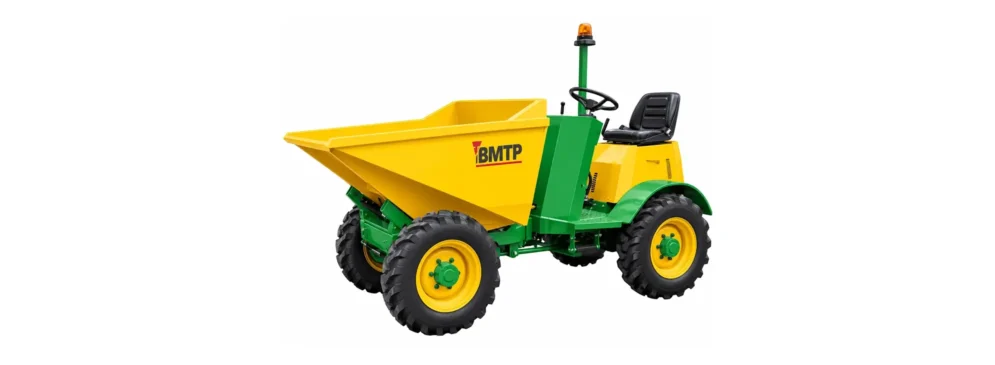
The BMTP Site Dumper range includes 4WD, an articulated chassis and power steering. These features support manoeuvrability in demanding site environments when the machine is operated within the manufacturer’s specified conditions.
The dumping method is an important selection factor.
A front tipping dumper discharges material forward from its skip. This arrangement can be suitable when the unloading area is directly in front of the machine, such as for general construction material handling, roadwork, earthmoving and aggregate transportation.
A swivel skip dumper provides greater flexibility when material needs to be discharged to different sides of the machine. It can be useful where site access is restricted or the dumper cannot always be positioned directly in front of the unloading point.
The BMTP specification also notes optional three-dimensional bucket rotation for suitable applications. The best configuration depends on the layout of the site and how materials need to be discharged.
Manoeuvrability is particularly important in confined construction areas. A mini dumper or compact dumper can be useful where access routes are narrow, while larger machines require sufficient space for turning and operation.
The BMTP Site Dumper features an articulated chassis and central seating. This configuration supports manoeuvrability and gives the operator practical visibility around the machine.
Operator comfort and visibility should not be overlooked. A dumper may operate for several hours each day, so practical controls and a suitable operating position can support easier operation.
The BMTP Site Dumper range lists central seating, power steering, a sun roof, warning lights and street lights among its features. These should always be considered alongside site safety procedures and the manufacturer’s operating instructions.
Transmission configuration can influence how a dumper performs in different applications. The BMTP range can be equipped with optional hydrostatic transmission, depending on the configuration.
When comparing machinery, discuss the intended application with the supplier to ensure the selected configuration is suitable for the project requirements.
The BMTP Site Dumper range is designed for construction and industrial material handling. According to the listed product information, the range includes:
The listed models are D 800 F, D 1200 F and D 1200 HD. Compare the machine configuration with the actual requirements of the project before making a decision.
Before choosing a site dumper, consider:
The right machine is the one that matches the project’s operating requirements—not simply the largest or lowest-priced option.
1. What is a site dumper used for?
A site dumper is used to transport and discharge bulk materials such as soil, sand, aggregates, gravel and construction debris around construction and industrial sites.
2. What is the difference between a front tipping dumper and a swivel skip dumper?
A front tipping dumper discharges material forward from the machine. A swivel skip dumper provides greater flexibility for discharging material to different sides. The right option depends on site layout and unloading requirements.
3. Is a site dumper suitable for uneven construction sites?
Site dumpers are designed for construction environments where ground conditions can vary. The BMTP range includes 4WD and an articulated chassis for demanding applications when used within the manufacturer’s specified conditions.
4. Which BMTP Site Dumper models are listed by Modena?
The BMTP Site Dumper range listed by Modena includes D 800 F, D 1200 F and D 1200 HD.
5. Where can I enquire about a BMTP Site Dumper?
You can contact Modena Machinery Trading LLC to discuss your project requirements and the suitable BMTP Site Dumper configuration.
Choosing the right site dumper is about matching the machine to the requirements of the construction project. Evaluate load capacity, terrain, manoeuvrability, tipping configuration, operator visibility and transmission before selecting equipment.
Explore the BMTP Site Dumper range or contact Modena Machinery Trading LLC for guidance on selecting a suitable model for your application.